From Shakespeare’s Sonnet XVIII. It’s not exactly a black out poem…think summer!
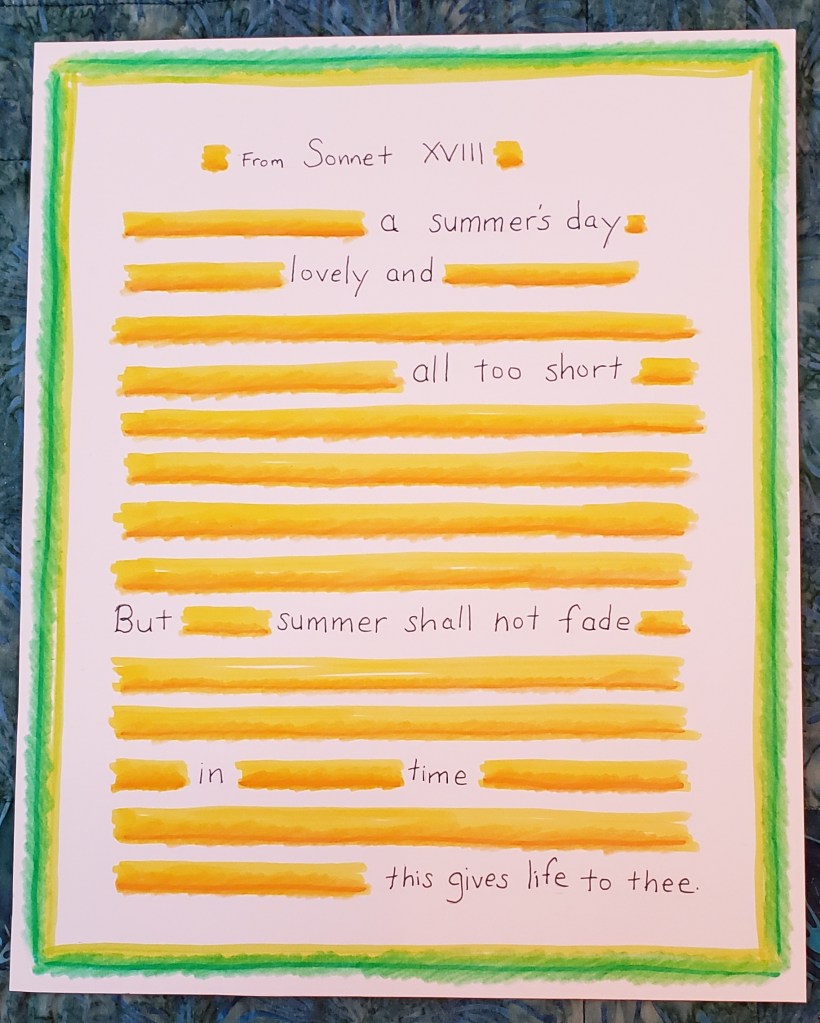
From Shakespeare’s Sonnet XVIII. It’s not exactly a black out poem…think summer!
Just two weeks ago, which seems like forever when you’re on quarantine time, I wrote about memories of an environmental education conference I attended several years ago. The story I wrote was mostly about bird calls, woodpecker drumming, and a bunch of environmental wackos, many of whom make me happy to now call friends. Those memories make me smile, and probably always will.
That story started, though, by me recognizing the bark of a persimmon tree on a trail near my home in north Alabama. I wasn’t able to recall the leaves when I saw them on a young tree, but when I saw them on a mature tree I instantly recognized the bark. “Alligator hide” was what I learned to think of when I saw it, because that’s what Big Dave called it. He’s not the first, and won’t be the last, person to call it that I’ve since learned, but he’s who taught it to me.
That’s one of the guys who was leading that naturalist hike that day, “Big Dave.” It was a while before I learned his last name is Hollaway, because everyone just called him Big Dave. He was indeed a pretty big guy at the time, and when he later lost a bunch of weight it felt kind of strange calling him that, but not really. His personality carried on where his size left off.
I’ll be honest: When I lead kids hikes or other environmental experiences, I have, since that very day some nine years ago, tried to put a little bit of Big Dave into my presentations and dialog. His gift of showing the natural world in a way that made sense just spoke to me. I watched him do all the “identify it stuff” as well as or better than most folks, but he also communicated how everything fit together. This tree, that bird, those deer: They were all there for a reason, and I’m not the only person who found myself richer after he shared the natural world with me.
The eastern towhee singing, “Drink your tea,” and the barred owl calling, “Who cooks for you? Who cooks for you all?” is old hat for me now, but back then when I learned it from Big Dave it was magical. In a lot of ways, it still is.
Dave had a way of seeing the spiritual–not the religious, and not the new age stuff–side of nature. As he walked you through the world, it was the foundation of everything he saw. He especially, as I remember, found a kinship with the birds of prey he worked with. The great horned owl, the red-tailed hawk, and even the diminutive screech owl: He had a kinship with all of them. If you’ve ever been eye-to-eye with one of those birds, you might understand where he was coming from. He saw a bigger picture than most.
I found out recently that Dave left this world a few days ago, and it hurts. I hadn’t spoken with him in over a year, but the towhees behind my back yard remind me of him often. And then, of course, there are the persimmon trees. They won’t let me forget.
Thanks, Big Dave.
—
Where am I going, I don’t know. I’m not sure? I know this though…I don’t get lost anymore. -From Dave’s Facebook page.
I’ve never met Mark Twain
or Samuel Clemens, for that matter
I’ve read some of his stuff though
and something he said has always
Sort of stuck with me
“I’m bothered,” I’ve read
“By those passages of scripture I do understand”
or something along those lines.
The quote changes
as such things will do over the years
He’d be, in the company of some folks
Alone with his thinking nowadays
“Blessed are the meek”
“Blessed are the merciful”
“Blessed are the peacemakers”
Oh, we still understand
Lots of us just aren’t bothered anymore
—
Scripture from Matthew 5:5-9 (NIV)
Nature is hard
For the feathered
For the furred and for the finned
For those creatures that crawl
For those that burrow or slither
Nature is hard
For you, for me, for those of us with the
Ability to read or understand these words
Life might not be easy
But it’s rarely as it is out there
Out there in nature
Out there, disaster usually means death
A broken wing or a strained leg
A spoiled source of water
A fallen nest or a disturbed den
Disaster like that almost always brings about the end
But sometimes–rarely, but sometimes
Disaster happens in the presence of hope
Hope in the form of human hands
That will scoop up and embrace
Human hands and a heart that strives to
Bring a wholeness to the broken and to
Preserve that which was surely lost
Sometimes
Rarely, but sometimes
—
A word on wildlife rescue and rehabilitation: While the fate of some animals might rest in the hands of humans, it is crucial that a would-be rescuer not make a difficult situation worse. Many times, animals that are “rescued” were never in any danger. Fledged birds, hidden fawns, and even box turtles crossing the road are oftentimes captured, putting them in an even worse situation.
Fledged birds on the ground are almost always being watched over by an invisible parent, fawns are left by parents, concealed for the day, and turtles (who unknowingly appreciate being assisted across the road in the direction they were headed) are territorial and will often perish in a new location.
If you find yourself in a position to help wildlife, please first contact a licensed rehab provider in your area for advice. Thank you!
The trail leads on
Invisible after only a handful of yards
Turning lazily through the oak and hickory trees that
Stand on this plot of north Alabama land
With the sun still below the tops of the trees
It’s an almost cool time of the morning
The July heat will come later this day
But for now we enjoy the morning shade
I look up to see fruit clusters
Pointing skyward from the branches
Of a stand of staghorn sumac
Burnt orange in anticipation of the crimson to come
Our grandchildren run ahead in search of their future
While my wife and I enjoy the company of their mother
With the world aflame beyond these trees
We live in and for the moment
And at this time, it is enough
It’s funny how little it takes to trigger a memory. One little event, and a whole lot of recollections. I love it.
My wife and I were out hiking early this past Sunday morning. I was checking out a trail where I’m soon going to be leading a kids’ hike. I haven’t been there in a while, and I like to prepare by checking out the lay of the land so I’m not just winging it.
As we started, I saw the leaves of a tree that I recognized but couldn’t identify. The name was right there, floating around my brain, but just out of reach. As we walked, I saw that type of tree a few more times, but just couldn’t figure it out. I snapped a few pictures, intending to look it up when I got back home.
We were more than half-way through the trail when I saw the leaves yet again, but this time on a mature tree. Mature enough to have recognizable bark. Recognizable bark that instantly told me the once-elusive name of that tree: It was a persimmon.
If Sunday’s hike was a movie, the landscape would have started to swirl around me, the wind would have whipped up, the sky would have darkened, and then everything would have been bathed in cloud-filtered sunlight. Oh, and it would have been a lot cooler. February cool, instead of July hot. I would have left where I was standing on a trail just south of Huntsville and been taken back to Lake Guntersville State Park some nine years earlier.
Nine years earlier, when I wasn’t doing things like preparing to lead a kids’ hike. Nine years earlier, when I wasn’t involved with environmental education at all.
So, to back up just a little bit further than nine years, this story all started with an email. It was one of those “all employee” emails that move around a school district, and this one caught my eye because it actually interested me. It was giving information about the annual conference of the Environmental Education Association of Alabama (EEAA). Couldn’t say I’d ever heard of such an organization, but I was curious. Truthfully, I was intrigued because it was an opportunity to go to a conference that I actually had a shot at attending, given that our school had just started an outdoor classroom.
A few exchanged emails, a bit of paperwork, a purchase order, and three of my friends–I mean, fellow teachers–and I were on our way.
Now, none of us had ever been to something like this, and we didn’t know what to expect. Environmental education…what was that? It was a three-day conference, and on the second day I learned what a persimmon tree looked like, but that wasn’t the memory that made me smile this past Sunday. Nope, it was the first evening that came flooding back to me. The persimmon tree was just the trigger.
We had pulled into the lodge parking lot sometime around late afternoon, and while there were signs directing us to the registration area, we still had that “not sure what’s going on” look about us. As would be expected, a few inquiries took us to the registration table. We were given a warm welcome, we got settled into our rooms, and soon we were seated in a largish conference room with 80 or so other people.
The four of us sat off to the side, a little more than half-way back from the front. Not quite the back pew, but you get the idea. The speaker, whose name escapes me, was giving a presentation on a research expedition in which he had recently taken part. The group was searching the swamps of Louisiana near the Gulf Coast, looking for signs of the ivory-billed woodpecker.
As a quick aside, the last verified sighting of an ivory-billed woodpecker was in the 1940s. The bird has a distinct knock, however, and while there hasn’t been a sighting in decades, there have been enough “hearings” that they’ve not yet been declared extinct.
The knock–two quick raps–is what got the ball rolling that night. Two quick raps. Now, the ivory-billed woodpecker is one of the largest woodpeckers in the world at around 20 inches long with a 30 inch wingspan, so those are two substantial knocks.
Go ahead, try it: Two hard knocks on whatever wood is available. I’ll wait.
That’s what everyone wanted to do that night. They wanted to try it, and they did.
So, the four of us were sitting there, surrounded by the growing sounds of people knocking on their tables. Then it got better, as folks started comparing the knocking of the ivory-billed woodpecker to other species. We heard the rapid, longer, steady pattern of the pileated woodpecker and the slower, shorter pattern of the small downy woodpecker. We heard the Morse code of the yellow bellied sapsucker and the rapid-fire machine gun of the hairy woodpecker.
By now, the speaker had both lost the audience and found a sidebar conversation himself. Things quickly progressed to bird calls, songs, and other vocalizations.
Folks, things were getting kinda scary for the four of us. It was loud, and on the verge of growing frenetic. All the while we were enjoying the ride and politely laughing along with many of the other participants. Well, our laughter started politely and then grew more raucous along with everyone else’s.
That’s what I remembered as my mind settled on “persimmon” the other day. That was my memory. The knocking, the bird calls, and the laughter.
Since I started this story with preparing for a hike, the conference obviously made an impression. Within a few years, two of the four of us were serving on the board of EEAA, and community environmental education is something I now do both personally and professionally as an elementary grade teacher.
Be careful: You never know where opening an email might lead.
—
If you’re curious, here’s a picture of the bark of a persimmon tree. You can probably see why I was able to recognize it.

Just a couple of poems. I’m sorry to say the first one is more of a memory.
Under the dark sky
Crickets sing the night away
Cacophonous joy
—
A nearly full moon
Lightens the mid-summer sky
Immutable hush
An observation: Teachers, generally speaking, don’t like to take tests.
I am, of course, painting with a broad brush, but that’s pretty much so true, in my limited experience. It’s our job–it’s my job–to teach and mold, then to assess. “Assessment drives instruction,” and all that. (I do believe that, by the way.) We give formative assessments and summative assessments, and we can tell you our opinion about the differences between a “spot check,” a quiz, and a test. We do formal and informal evaluations and put together qualitative and quantitative data. We give tests. It’s part of what we do.
But, again, generally speaking, we don’t like to take them. Ahem. Okay, I don’t like to take them.
The odd thing is, with most tests, I do well. Multiple choice is preferred, because like so many other students I’m able to look at the options, eliminate a couple right off the bat, and make (more) sense of one of the remaining answers. Essay questions aren’t too bad, either, because (according to some) my BS degree didn’t just mean Bachelor of Science.
Okay, this slice isn’t about testing, it’s about taking a test. Specifically, me taking a test.
I’ve been an elementary (PK-5) STEM coach for the last three years, and I’ll serve in that capacity again this upcoming year. After that, though, I’m almost certain to go back into a general ed classroom. That, by the way, is a good thing for me. Hopefully, I’ll go back into a third-grade classroom, but I’m willing to give other grades a shot. Anyway, I was recently given the opportunity to be part of a LETRS (Language Essentials for Teachers of Reading and Spelling) cohort here in Alabama. I’m all about some good professional development, and I’ve heard positive things about LETRS.
I did the registration thing, and a few days later received an email letting me know dates and times for my orientation webinar. I signed up for a session that worked for me, and there I was last Friday, sitting in front of a computer, getting ready to learn.
My presenter was good: She delivered the information with a light-handed approach, added just the right amount of humor, and didn’t read her slides word-for-word. There was that moment, though, when I could feel hundreds of teachers from all over the state being jolted–just a tiny bit–from their webinar haze when they heard the word “pretest.”
Say what?
Then, there it was again. “Pretest.” Then, she said words like “post test” and “check on learning.” I think she even tossed in, “demonstrate mastery.” Whoa.
So that’s the way you want to play it, eh?
To make it even better, the two-hour block of time we were asked to set aside for the webinar actually included the aforementioned pretest. I was supposed to do it that day.
In retrospect, the situation was pretty funny (at the time, though, all I knew was I needed to take a test). I mentioned my B.S. (the degree) earlier, but on Friday I was thinking about the fact that I was about to be assessed on my knowledge of teaching reading after having earned my master’s degree a few years back in, you guessed it, elementary reading. No pressure.
And, it went okay. I showed I had room for growth as a teacher, but I didn’t embarrass myself (sometimes the hardest tests are the ones where only you know your results). I’m looking forward to this training, but don’t doubt that I’ll still clinch up just a little bit as I wrap up each lesson and unit with the assessments. I can do this–I know I can.
—
Thank you to Two Writing Teachers (https://twowritingteachers.org) for hosting the Slice of Life Story Challenge. If you’re a teacher who teaches writing (and, really, there aren’t many K-12 teachers who don’t in some capacity), you should check out the challenge and give it a shot!
Walking through a nursery
A nursery of plants
Is to stroll through the potential
Of the future
The future of a different space
Each plant can be lifted
Lifted from the pot
Soil falling through your fingers
And placed into a new place
A place, a void, a hole that was prepared
Just for that plant
Walk the rows
Browse
Dream
See tomorrow
With any luck, I saved a life yesterday, all because I got there first.
Wow, when I put it that way, it sounds so cool.
Like a lot of people, I’ve got a love/hate relationship with social media these days. I love the fun, happy stuff, but not so much the opinion stuff (that was the nicest way I could put it). One of my least favorite types of post, especially if I get there after a bunch of people have commented, is the snake post.
Yes, the snake post. As in, “OMG, I found a snake near my house.”
I get it. I have fears, too, some irrational. Heights is mine. I’ll go up, I’ll look around, I’ll do what I want to do, but that doesn’t mean I won’t feel queasy while I’m doing it. Fun fact about me: Standing on a 35-feet-tall tower makes me nauseous, but once I can hang off it on a rappelling rope, still more than 30 feet off the ground, I’m fine. Adrenaline, I guess.
Snakes, though. The fight or flight thing, the cultural thing, the what-I-learned-in-church thing, and even the “did you see the size of that thing” thing: I get it, but honestly, I sort of don’t. Like I said, that’s not my fear. For sake of discussion, though, I get it.
Back to me saving a life: I opened up Facebook early yesterday, and saw where a co-worker of mine posted that she had been surprised to walk out of her house to find “THE MOST GIGANTIC BLACK SNAKE!!” Yep, two exclamation points. It was that big!
I immediately looked at the comments, fearing the worst. For some reason, people usually encourage the snake’s demise. For some other reason, people often share pictures of snakes they’ve cut into pieces to show how they handle them. Sigh.
But, there were no comments. Ha! I was the first–she had just posted it!
Quickly I typed, “Good news: He’s harmless. 
And it worked! My friend’s reply was to hope “she” didn’t have any babies around, but she (my friend, not the snake)–and the commenters that followed–didn’t figuratively pile on the snake. Whew!
I’m glad the snake made it, and I’m glad my friend was okay after her experience. Most of the snakes we encounter in my area are non-venomous and harmless to people. Mice, voles, and rats though? They don’t much care for the snakes, and that’s fine with me.
Polonius got that one right...
Ponderings to Keep
Reflections on my life as a teacher, reader, writer.
Polonius got that one right...
Polonius got that one right...
Polonius got that one right...
Blogging my way through the year
Polonius got that one right...
Polonius got that one right...
shouting my heart out for all who may listen
Polonius got that one right...
Lit On Fire!
"It would be nice if you could just ravel out into time."
 Yet There is Method
