I remember my muscles tensing and my body freezing, my eyes growing wider as my mind started to race and adrenaline started to pump.
“I don’t remember how I used to explain why dividing fractions oftentimes ends up with a quotient larger than either the dividend or divisor.”
A few panicky seconds passed.
“Oh my gosh — I can’t remember, I can’t remember,” I said to myself, over and over.
I searched for the answer in my mind. I worked examples, looking for the pattern that was going to -click- make everything fall into place. I knew this, but I just couldn’t remember.
“I have got to know this. I can’t just say ‘flip the second fraction and multiply,’ without being able to explain why.”
I looked at the clock, on the off chance that it might give me the answer.
2:40 A.M.
Knowing that I don’t start teaching fourth grade for another two and a half months, I did my best to let it go, telling myself I could look it up in the morning. “Besides, that’s not even a fourth grade standard,” I added for good measure.
To my later-in-the-morning amazement, I actually went back to sleep.
The driver ahead of me hesitated physically straddling the line between turning or not as one does when a decision is uncertain.
It was a small car, road-dirty with out-of-state plates and a single occupant, a man whose greying hair was visible in the early morning light.
As I would too, he pulled through the light in the turn lane and it was curiosity, I confess, that soon had me alongside him for just a moment before pulling ahead.
Perhaps mid-60s, needing a shave but not a haircut. A look of concentration with his left hand on the wheel and his right clutching a sheet of paper.
A few moments later I looked for him in the mirror, but he was gone. Where was he going, this far from home? Where was I going, this close to home?
Shaking the thought, I slowed once more dutifully put on my signal and made a turn into the rising sun.
No, really. Their eyesight is near the top of the charts. Their vision is better than ours during the day, and there’s that whole night vision thing they’ve got going for them.
Their hearing? Well, their hearing is enough to make one wonder why we even have charts. They don’t need to see their prey in order to capture it — the sound of a rustle in the grass or even the beating of an excited heart is more than enough for them to locate their next meal.
Owls don’t typically have much of a sense of smell, so that works in the favor of any would-be sneaker, but that’s about it.
All of that said, I recently found myself wishing I could sneak up on an owl.
An owl who was awaiting my arrival.
A hungry owl — an apex predator — who was waiting for me.
—–
Okay, really, I just needed to feed Max.
I’ve written before about the volunteer work I do with the RISE Raptor Project here in north Alabama. We’re a small stewardship and conservation education organization that works with birds of prey to communicate our message to the public.
Those birds have to eat, and it was my turn to feed them. Max’s food, though, was still frozen, so my presence — which should have meant dinner was about to be served — didn’t really mean a meal was imminent. That’s why I wished I could bring my car up a gravel driveway, turn off the engine, shut the door, unlock and open the building he stays in, thaw his food, and go into his enclosure, all without him knowing I was there. As if.
He knew I was there.
Did he let me know he knew? Yes.
Did I thaw his dinner as fast as I could? Yes.
He gave me grief in the form of an impatient squawk until I finally fed him some 20 minutes later, but he did eventually get his well-thawed meal.
Did he shower me with thanks afterward?
Well, no, not really. He was quieter, though. I guess that counts.
A picnic table sits beneath a spreading white oak tree just outside the building where I spend many of my days extending an unspoken invitation to all who walk past it.
Perched on a slight incline, it is bathed in deep, cool shade, and a breeze has, more often than not, accepted the invitation and it, in turn, entreats passersby to do the same.
Were it not for the heavy chain tethering the table so close that the tree itself takes two of the end seats that haven on the hill would be perfect.
Enjoy the table, but don’t steal it. Things are complicated.
Honestly, in a lot of ways, it was as if we were kids looking at a roller coaster, saying, “I’ll do it if you do it!”
Except it wasn’t a roller coaster, and my mother and I weren’t kids.
—–
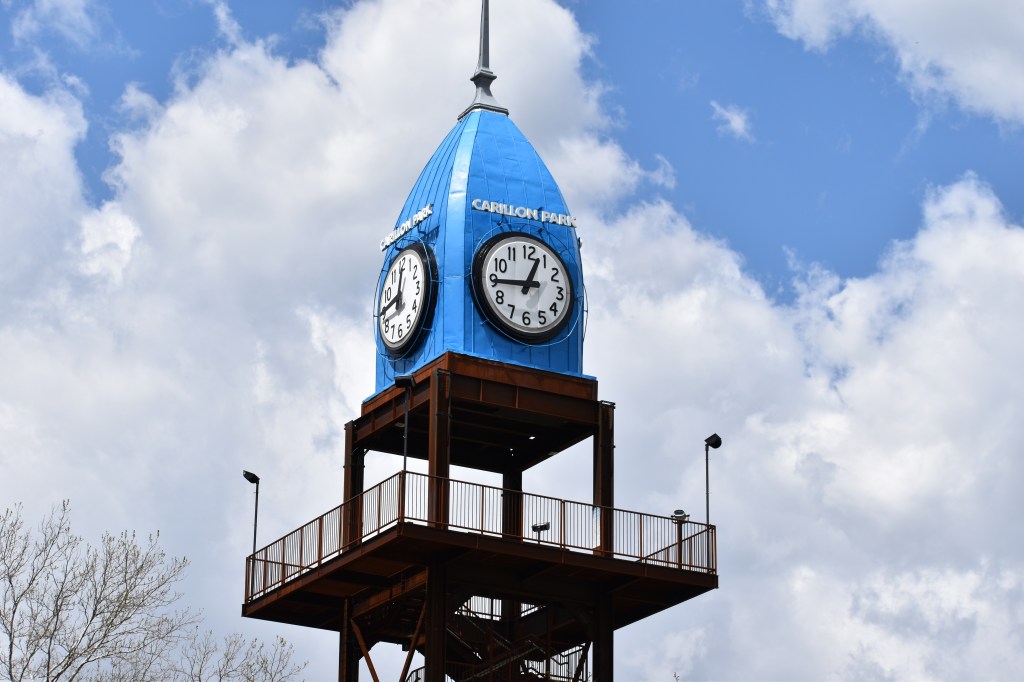
Dayton, Ohio, is a city with a lot of history. I know there are a lot of cities with history, but Dayton is mine, so I’m a bit partial. Part of the city’s history — and there is a lot — is embodied in what is known as the Callahan Clock.
Until the late 1970s, this clock stood atop Dayton’s first tall building, the Callahan building. When that building was taken down, the clock was removed from its 14 story perch and moved to another building near Interstate-75, giving it even more visibility to those moving through the city.
That location was eventually torn down as well, and until two years ago the clock sat on the ground in Dayton’s historical Carillon Park, home of the Wright Brothers museum and its airplane, the Wright Flyer III. (I told you Dayton had a lot of history–oh, yeah, the whole “birthplace of flight” thing.)
In 2019, the clock was placed atop a tower built in Carillon park just to hold it, a structure known as the Brethen Tower.
“The tower” that started this narrative.
Now, the tower itself isn’t necessarily a thing of beauty. The clock is, but the tower is a simple structure made of I-beams and steel grating.
Therein lies a problem.
It’s 120 steps to the top, and every one of those steps is made of a rock-solid-no-way-you-can-fall piece of steel grating firmly welded to the structure itself.
Just because you can’t fall, though, doesn’t mean you can’t see through it. As you climb it, there’s never a time when you’re not aware that you’re getting farther and farther from the ground. I climbed it, and I’ve got the pictures to prove it, but that doesn’t mean I was comfortable doing so.
Once we were there, however, we were rewarded with a view of the downtown area as well as a fantastic vantage point from which my mom and I could look at another attraction: a bald eagle nest. Currently occupied by a pair of eagles with three maturing eaglets, it’s a sight to see, perched at the top of a large sycamore tree on the edge of the park.
We came, we climbed, and we saw.
“Okay, I’m ready to go down now.”
“Okay, me too.”
The Callahan Clock, Dayton, OhioBald eagle nest, Carillon Park, Dayton, Ohio
A few days ago, I posted about providing a line to this year’s Kidlit Progressive Poem. Organized this year by Margaret Simon of Reflections on the Teche, there were 30 different poets who contributed to the project. They are all listed after the poem.
In addition to the final line of the poem itself, Michelle Kogan created a beautiful illustration for the work. I don’t have permission to share the illustration, but it can be found on the poems archive page here: 2021 Progressive Poem. It’s beautiful, and definitely worth checking out!
Progressive Poem, 2021
I’m a case of kindness – come and catch me if you can! Easily contagious – sharing smiles is my plan. I’ll spread my joy both far and wide As a force of nature, I’ll be undenied.
Words like, “how can I help?” will bloom in the street. A new girl alone on the playground – let’s meet, let’s meet! We can jump-skip together in a double-dutch round. Over, under, jump and wonder, touch the ground.
Friends can be found when you open a door. Side by side, let’s walk through, there’s a world to explore. We’ll hike through a forest of towering trees. Find a stream we can follow while we bask in the breeze.
Pull off our shoes and socks, dip our toes in the icy spring water When you’re with friends, there’s no have to or oughter. What could we make with leaves and litter Let’s find pine needles, turn into vine knitters.
We’ll lie on our backs and find shapes in the sky. We giggle together: See the bird! Now we fly! Inspired by nature, our imaginations soar. Follow that humpback! Here, take an oar.
Ahh! Here comes a wave – let’s hold on tight, splashing and laughing, let’s play until night! When the Milky Way sparkles, and the moon’s overhead, we make a pretend campfire and tell stories we’ve read.
Some stories are true and some myths of our time. I love all of them, but my favorite ones rhyme! With windows to see other lives, other places We’ll find and treasure a rainbow of faces.
When you open your heart to a new friend kindness for another kindles and ascends
Here’s a list of everyone who had a part of this year’s project:
It was a sincere question and honestly I had to think for a few seconds before I answered.
The easy answer the one I didn’t give was it couldn’t be anything else.
With those compound leaves it wasn’t any of the oaks or maples redbud was out of the question as was beech and tulip poplar.
With those leaflets as small and numerous as they were ash, hickory box elder buckeye and even pecan were off the list.
But on that late April morning it was more than just seeing what it wasn’t
It was seeing what it had to be.
With those dangling clusters of wondrous white flowers laden with nectar, pollen, and bumble bees
It had to be a black locust. It couldn’t be anything else.
“It’s the flowers,” I said with a smile.
Just a note:
I know and understand that most people don’t know how to identify the trees around them. Or the flowers, shrubs, and grasses. There are so many I don’t know . . . lots more than I do.
In the early grades, we often use what’s known as “environmental print” to help students to read. Environmental print is helpful because almost everyone, even children at a young age, can recognize it — it’s ubiquitous and you know it at a glance.
When I learn with people — especially young people — outdoors, it’s my hope that they would develop a familiarity with the world around them. Much like recognizing the M that is the golden arches, it would be great if, at a glance, we could recognize the plants and animals around us.
To paraphrase Aldo Leopold, we can’t love what we don’t know.
Man vs. nature I would write in the margins back when I was made to do such things
I remember that along with man vs. man and man vs. self — conflict
Now, some forty years later as I walk the trails and see what I see
I wonder why I never wrote nature vs. man I wonder why
back when I was made to do such things
—–
Just a note: I understand we more-accurately say character instead of man these days. This poem takes me back to the 70s. A lot of things were different back then. (And a lot of things weren’t.)