Spring is Here

It’s impossible, I believe, to finish this sentence in a manner that pleases everyone: “The hardest thing about the pandemic has been _______.” 

People have lost so much, and those losses are, in many ways, both alike and different for everyone.  Lives have been lost, health has been lost, jobs have been lost, and families and friends have been kept apart for the common good.  In addition to these few examples, there are many other situations, some of them unique, but most of them shared in some manner by others.

That said, the last loss I mentioned–the loss of community–is starting to make a comeback.  Sometimes I think it’s growing stronger because of the shared sense of responsibility to do it in a way that seems right.

There are, of course, a variety of relatively new ways to communicate through the use of technology, but the last few days have reminded me how some of the older methods are still valuable.

I’ve seen people sitting together outside.  That’s a lot easier here in the south, but I’ve heard accounts of it occurring in the colder climes.  If we want to be together, we’ll figure out how to do it.

I’ve seen people engage in outdoor activities.  The hiking trails in my area haven’t seen this much use in, well, perhaps forever. Bicycle stores and outdoor equipment stores are seeing more business.

In my limited experience with them, even online groups are seeing their sense of community growing through offline avenues.  I’ve sent and received cards and letters (one just yesterday!) from people with whom my relationship would probably have stayed virtual were it not for a heightened sense of connection brought on by our shared experiences. 

This first day of spring is, metaphorically speaking, not just a time of renewal after a long season of meteorological winter.  These days hold a sense of hope that a figurative winter is ending as well.  May that be so. 
The Day After and All Is Well

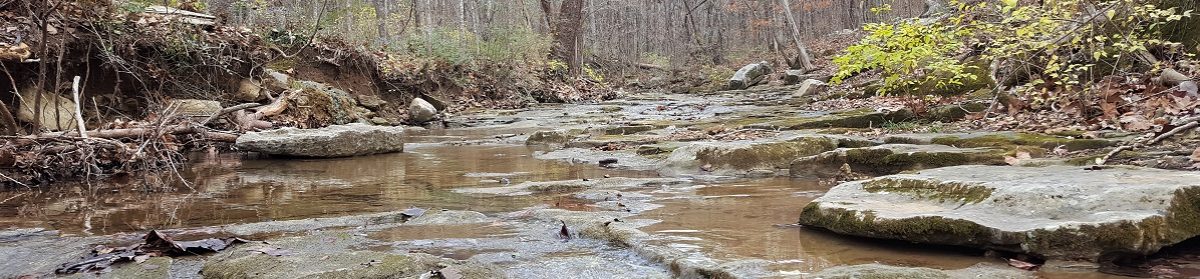
It’s the day after the severe weather day I wrote about yesterday.  It’s dark, so I don’t know if the ephemeral creek is still running through my back yard.  I don’t know if there is any damage to the house or trees, but I don’t believe so, as most of the worst passed to the south of us by a county or two.  The “event” lasted well into the night, though a look at my Twitter feed shows our tornado watch was cancelled just before 11:00 PM.

I’m thankful, of course, that we were spared the worst of the weather, and hope recovery is quick for those who weren’t (I haven’t heard of major damage or injury from yesterday (update: there was major damage throughout central Alabama)).

I’m glad I’m not a meteorologist.  Like a lot of people, I’m fascinated by today’s technology and the ability it gives us to see the bigger weather picture, but I’m happy I don’t have any responsibility to use it well.  I’m thankful there are those who do carry that responsibility, though, and that they were there for us yesterday.

It’s a new day; y’all be safe out there.

The Weather Day I Don’t Want

We don’t have a water cooler at the district office, and, if we did, it would probably be covered with a plastic bag and tape like all the other water fountains in the district because of, well, you know, the pandemic.

That said, the gossip around the figurative water cooler yesterday was all about today’s weather and if we’d be out of school because of it.

March is a funny time of the year.  Some schools around the United States are still experiencing weather days because of snow, but here in Alabama those days are typically behind us.  While we have had snow days in March before, our weather days this time of the year are usually for “severe weather” (read: tornadoes).

Today is just such a day.  Today’s risk level for where I live: “enhanced.” 

We haven’t always taken weather days for forecasted severe weather, and sometimes I talk to people who are just a bit (or a lot) incredulous that the district–much less the state–would shut things down for weather that hasn’t yet occurred.  

The answer to “why?” around these parts usually comes in the form of a date, and that date is April 27, 2011.  

Severe weather was forecasted that day, but I certainly don’t remember there being any talk of keeping kids home.  

What I do remember is huddling in the hallway as tornadoes (plural) moved within sight of our school.  I do remember taking a different route home that day because my normal one was blocked by fallen trees. I do remember finding a piece of mail in my front yard that evening.  It was an old Visa bill that belonged to one of those who lost his life that day; he lived nearly 100 miles away to the southwest of my home.

To quote from the National Weather Service website, “there were 29 confirmed tornadoes in Central Alabama on this day, and 62 confirmed tornadoes across the State of Alabama.”  It was a rough day.

It’s early as I’m posting this, and the day is ahead of us.  Be safe, everyone.

Alulae

I don’t like to speak in absolutes about many things, but I think it’s safe to say everyone misses something from the time before this pandemic we’re still moving through.  A lot of things, most likely.  I woke up this morning and was reminded of one of those things that I miss. 

As I got my day started, I saw that my brother sent me a message sometime after I turned my phone off last night, and when I opened it, I found a video that someone had posted to social media.  The video was of a parrot, apparently a younger juvenile because its feathers were still coming in.  There was music playing in the background, and the parrot was “dancing” as I understand they love to do.  I don’t know any parrots personally, but they seem to be creatures with outsized personalities.

Anyway, despite the early development of this bird’s feathers, I could see the alula on its left wing as it moved around.

Bird nerd alert: I like to talk about things like alulae.

When a bird is standing with its wings tucked, the part of the wing that is visible is–I’m using equivalent terms here–its fingers.  That rounded part of the wing closest to the head is what we would call our wrists.  

Birds, we know, don’t actually have fingers or wrists, but we do, so they’re convenient for a demonstration.Tuck your elbow close to your body, hold your wrist up by your shoulders, and point your fingers back toward your arms as best as you can.  There you go–you’re sitting like a bird.

Anyway, a bird has two or three feathers that grow from that wrist area.    Unlike most of the feathers on their wings, these are fully controllable and aid in maneuvering, oftentimes during landing. They act sort of like slats do on an airplane, providing a sort of fine tuning when needed.  Those feathers are called the alula (plural alulae–they’re Latin words).

To review, though: birds don’t have fingers, wrists, or slats.  I’m just trying to keep things straight here.

It won’t be too long, I hope, before I’m able to talk to people about birds again.  I’m a volunteer with an organization here in the Huntsville, Alabama area that does conservation and stewardship education using birds of prey.  During normal times we do presentations at libraries, schools, and other community events.  Those haven’t happened in a while, but things look promising for the summer.  I’m hopeful, but we’ll see!


If you’re curious, we’re at http://riseraptor.org. Check us out!

The Hard Part

“Just so y’all know, this is the part of the trail that gives the hike a “difficult” rating on the website description.”  A bit out of breath myself, I spoke that sentence in three fairly distinct parts, pausing after “know” and “hike.”

“How long is this difficult hike?” the person behind me asked.

“It’s a total of about four miles,” I replied back, those words coming out in a single breath.

“No, I mean how long is this difficult hike.”

I was missing something, and I was pretty sure it was my fault.  “Just about four miles all together.”

“I mean the difficult hike; the difficult part.”

“Oh, sorry, I didn’t understand!  That’s only, well, not even 200 yards, and then we’re as high as we’re gonna climb.”

And then we stopped talking, concentrating on navigating the limestone boulders, tree roots, and pockets of dried leaves and gravel that made up the trail beneath our feet.

Sure enough, within minutes we were at the highest contour line on the map we were to see that day, having just left nearly 20 or so of them behind us.  I thought it a good time to stop for a drink of water and to check out a small waterfall, mostly so that, you know, the others could catch their breath.

Wherever you’re at, reader, take time to get outside.  Spring is almost here, even if it’s still covered with snow in some places!

—–

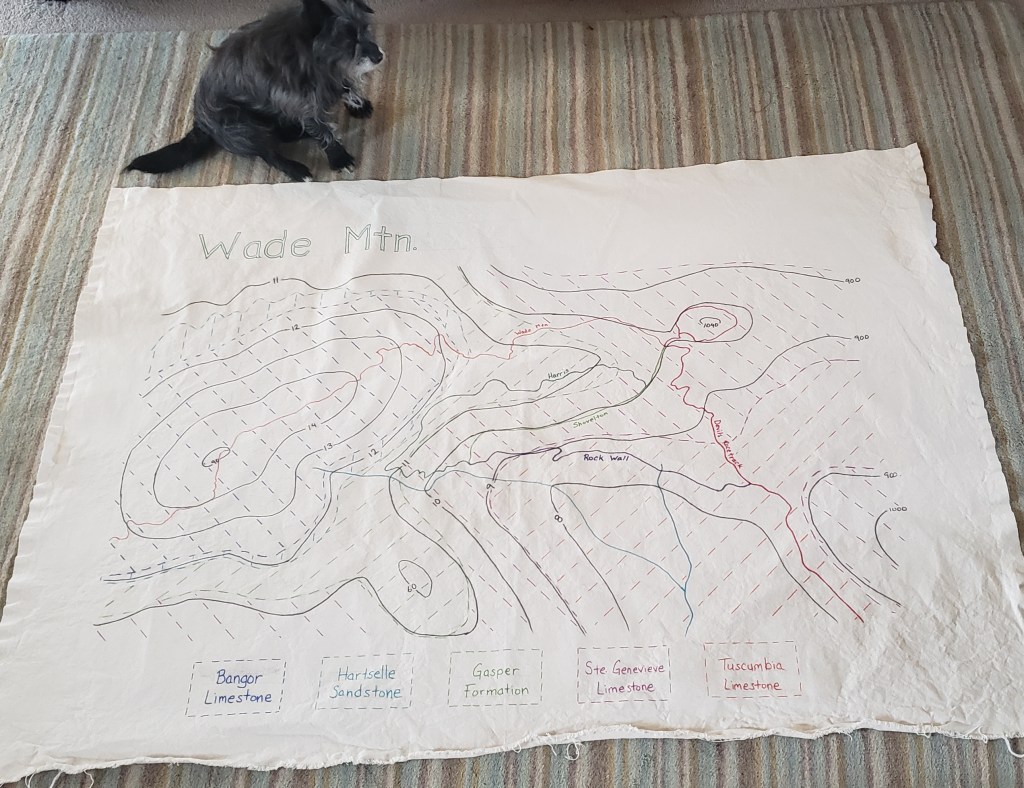
Map geeks: Here’s the trail map for the hike we were on during this conversation.  We were heading west on the Harris trail (near the middle of the page), having just left the intersection of the Shovelton and Rock Wall trails behind us.  The contour interval for the map is 10 feet.

If Tim Makes a Map

I can’t decide: does my situation best go with Lewis Carroll’s Alice’s Adventures in Wonderland, or Laura Numeroff’s If You Give a Moose a Muffin

I think I’m going to go with the moose. The rabbit hole is tempting, but the moose situation is probably more accurate.

On occasion, I lead hikes for the local Land Trust here in north Alabama.  Like most people who do that sort of thing, I enjoy being outdoors, I enjoy being with people outdoors, and I enjoy talking with people about the outdoors.  Plus I’m a willing volunteer–that’s my number one qualification for the job.

For better or worse, I’m a teacher.  If I know something, I want you to know it too.  Fortunately, I have social filters and can detect when other people don’t want to know what I know, so things usually work out okay. 

Anyway, back to the moose conundrum.

If you ask Tim to lead a hike, he’s going to probably say yes.

If he says yes, he’s going to want to do a good job telling people about the area.

If he’s going to tell people about the area, he’s going to do some research.

If he does some research, he’s going to find a way to best communicate what he’s learned.

If he’s trying to best communicate things to a group, he’s going to make visual aids.

If he’s making visual aids, he’s probably going to spend most of the weekend before the hike making something like a map. A big map.

If he spends most of the weekend making a map, he probably won’t finish the baseboard molding to wrap up his kitchen floor installation.

Or do much else, for that matter.

On the bright side, I’m pretty happy with how the map came out!

Lulu for scale.

Don’t Trip!

I’ve seen the diverse Alabama countryside many different ways: hiking, of course, but also from the seat of a bicycle, speeding along the road in a car or truck, and even out the window of an airplane.  My least favorite way to see things?  That would be lying on the ground wondering how I got there!

The topography of Alabama is varied, and that’s an understatement.  The northern part of the state, known as the Highland Rim, has rolling hills and plenty of relatively flat ground.  

Moving toward the northeast corner of the state takes you into what’s known as the Cumberland Plateau, an area of low mountains that extends along the southern edge of the Highland Rim westward almost to Mississippi.  

Moving south of the Cumberland Plateau takes you into two more-mountainous regions, the Valley and Ridge region and the Piedmont Upland region.  These regions also extend about two-thirds of the way across the state toward the western border.

Alabama has a fifth region, the Coastal Plain, that covers the remainder of the state–well over half of the total land area. Relatively flat, its land was once under what we now know as the Gulf of Mexico (actually, the whole state was, but that was a lot earlier).

The other day, I was hiking on a trail at the transition between the Highland Rim and the Cumberland Plateau.  The trail had the best of both regions: high, but well-worn limestone hills, and relatively level flats.  I had spent the previous hour navigating a higher trail, carefully placing my foot with nearly every step.  

It was the lower part of the trail that got me, though: an almost level stretch through a stand of trees mostly consisting of maple, oak, and hickories.

I was walking along, my mind a dozen other places, when–I promise this is true–a root just reached up and grabbed my foot!  Falling is a peculiar sensation, especially when one is not used to doing so.  I’d love to say that I was graceful, executing some sort of tuck-and-roll or something, but no…I just fell.  

Left-hand-right-hand-left-knee-left-shoulder-boom. 

Quickly I was back on my feet, despite the fact that there was no one within site to give witness to my crash-and-burn.  I’m old enough to feel the need to go through the checklist to see if anything hurt worse than my pride.  With the exception of a small chunk of skin missing from my left ring finger, I was fine.  Given the fact that I was by myself, I was happy to find all systems were a “go.”  

Folks, enjoy the outdoors, but watch where you put your feet!

Spring Chorus

I don’t know where
but there is water
in the tree line across the way

Water from the Gulf of Mexico
dropped below the foothills of the Appalachians
for a season

Vernal pools
shallow, ephemeral
long gone by the time summer arrives

I stand, on these cool spring nights
and listen from a distance to the frogs
who tell me of those pools

Mountain chorus frogs
unaware they were left behind
when their mountains took a long, slow walk

to the ocean

Don’t Step in That

Lately, I’ve been walking the trails of a local Land Trust property for exercise.  In my mind, what I’m doing is different than hiking because, well, I’m not walking as slow as I normally do; I’m not observing like I normally do.  I did see a pretty cool cedar apple rust yesterday, though, and today?  Well, today I didn’t step in it.

I was moving pretty quickly for an older guy, and surprised myself at my own agility as my foot swung wide mid-stride to avoid the furry little pile sitting in the middle of the trail.

Coyote.  Segmented but ropey, filled with fur–yep, it was coyote poop.

Here’s the deal: coyote’s mark their territory in a number of ways, including with their droppings.  Seriously, they go out of their way to poop on the trail.

Three thoughts went through my mind after the initial identification and avoidance maneuver.  The first was, “I’m glad I didn’t step in that.” The second was, “I’m glad I’m not the one who did,” as the edge of the pile was, apparently smeared away by a boot or shoe.

The third?  Well, I had to rap.  You know, a sing-songy rhythmic chant.  A rap.

It starts with an S and ends with a T
It comes out of you and it comes out of me
I know what you’re thinking–don’t think like that
Think like a scientist, and call it…scat.

I love being an environmental educator. People, watch where you walk out there!

Split Horizons

Polonius got that one right...

Pocketful of Prose

Ponderings to Keep

Ms. Victor Reads

Reflections on my life as a teacher, reader, writer.

Merely Day By Day

Polonius got that one right...

I hablo espanglish

Polonius got that one right...

Live Your Poem...

Polonius got that one right...

Katie's Korner

Blogging my way through the year

The Biblio Bard Blogger

Polonius got that one right...

Poeturescapes

Polonius got that one right...

Soapbox: The Way I see Things

shouting my heart out for all who may listen

TeacherReaderWriter

Polonius got that one right...

litcoachlady

Lit On Fire!

Mar de Meditaciones

"It would be nice if you could just ravel out into time."