“Oh-my-gosh-do-you-guys-know-about-tree-farts?!”
There was, for a second or two, a silence among the members of the group. Glances were exchanged, weight shifted from foot to foot, lips were pursed, and brows were furrowed. The only sound was the steady rain hitting the brown leaves covering the ground, and perhaps a bird or two in the distance.
And in that north Alabama woodland, there was curiosity–curiosity that manifested itself in a sudden and concurrent movement toward the tree which prompted the outburst a moment before.
A large tree, perhaps an oak or maple, was apparently oozing bubbles from a spot on its trunk some 10 or 12 inches off the ground. If the weather was warmer and the foam on a smaller plant, a spittle bug might have produced the phenomenon we were seeing. But the weather wasn’t warm, and the plant bearing the foam stood above us some 40 feet off the forest floor.
“Yeah! I was listening to a podcast about it just the other day. It turns out that trees absorb methane and other gasses from microbes in the soil. The gas travels up the tree through the xylem and comes out from breaks in the bark.”
There it was, right in front of us: foam that appeared, indeed, to be tree farts.
“But, it looks like this might be coming from water running down the trunk of the tree. Maybe it’s a physical thing, those bubbles that are forming.” This insight came from another member of the party, her eyes mere inches from the trunk as she knelt there on the humus and leaf litter around the tree.
So we all had to take a close look, one after another, at the foamy mass.
We were a group of eight educators, out for the morning to explore the oak-hickory forest on this Alabama hillside just a few miles outside the city of Huntsville. Our gathering was an event held as part of the state’s environmental education association’s annual conference. This year, given the circumstances of the pandemic, it was an “unconference.” No group meetings, no dinners, and no large-scale socializing with friends from around the state. As an environmental education group, though, we were able to keep our field trips as they’re all held outdoors.
Environmental educators being the people we are, we weren’t deterred by the steady rain falling over the northern third of the state. Truth be told, I believe some of us took a strange pleasure in being out in the inclement weather, but that’s just my opinion.
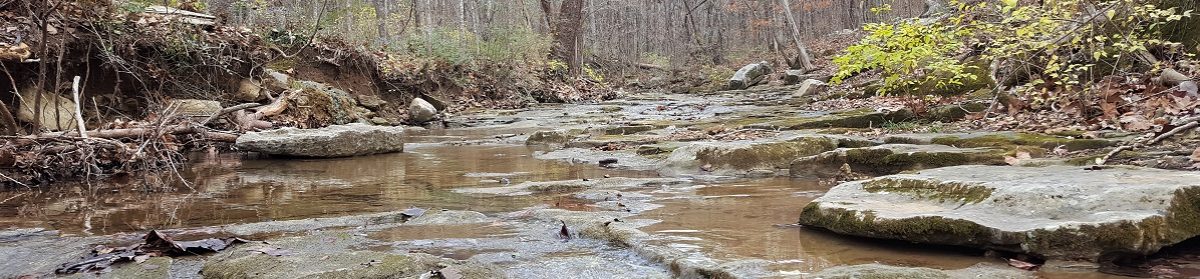
The steady rain, the result of a slow moving weather system, gave us a forest filled with the sounds of running water. Without it, we wouldn’t have experienced the boisterous creeks and ubiquitous rivulets of water that flowed around us as we walked. More often than not, the limestone trails we trod upon were those rivulets, and I walked more carefully than I normally would.
I’m not sure we ever came to a consensus on the bubbles. Later that day I did a bit of reading and learned that trees do carry gasses such as methane and carbon dioxide that were produced through microbial digestion in the soil. Those gasses are released through breaks in the bark of the tree, and, well, if methane released through a crack isn’t a tree fart, I don’t know what is.
But the bubbling could have been a result of water traveling down the trunk of the tree. Later during the hike we observed a similar occurrence, though higher off the ground; this time, it did appear to be more of a physical process.
That’s why we were there, though: to learn, to explore, and–perhaps most of all–to be curious. As our group broke up sometime in the early afternoon, one of the participants proclaimed her joy at being with like-minded people. I couldn’t have said it better, and I can’t wait to go again.
—
Most states have an environmental education group of some sort. Here in my state, we’ve got the Environmental Education Association of Alabama (https://eeaa.us). To find an organization in many of the other 49 states, you can check the North American Association for Environmental Education’s affiliate directory at https://naaee.org/our-partners/affiliates.


 Yet There is Method