The Tower

“Do you want to climb the tower?”

“Sure.  Do you want to climb the tower?”

“Sure.  Let’s go.”

Honestly, in a lot of ways, it was as if we were kids looking at a roller coaster, saying, “I’ll do it if you do it!”

Except it wasn’t a roller coaster, and my mother and I weren’t kids.

—–

Dayton, Ohio, is a city with a lot of history.  I know there are a lot of cities with history, but Dayton is mine, so I’m a bit partial.  Part of the city’s history — and there is a lot — is embodied in what is known as the Callahan Clock.  

Until the late 1970s, this clock stood atop Dayton’s first tall building, the Callahan building.  When that building was taken down, the clock was removed from its 14 story perch and moved to another building near Interstate-75, giving it even more visibility to those moving through the city. 

That location was eventually torn down as well, and until two years ago the clock sat on the ground in Dayton’s historical Carillon Park, home of the Wright Brothers museum and its airplane, the Wright Flyer III.  (I told you Dayton had a lot of history–oh, yeah, the whole “birthplace of flight” thing.)

In 2019, the clock was placed atop a tower built in Carillon park just to hold it, a structure known as the Brethen Tower.

“The tower” that started this narrative.

Now, the tower itself isn’t necessarily a thing of beauty.  The clock is, but the tower is a simple structure made of I-beams and steel grating.

Therein lies a problem.

It’s 120 steps to the top, and every one of those steps is made of a rock-solid-no-way-you-can-fall piece of steel grating firmly welded to the structure itself.

Just because you can’t fall, though, doesn’t mean you can’t see through it.  As you climb it, there’s never a time when you’re not aware that you’re getting farther and farther from the ground.  I climbed it, and I’ve got the pictures to prove it, but that doesn’t mean I was comfortable doing so.

Once we were there, however, we were rewarded with a view of the downtown area as well as a fantastic vantage point from which my mom and I could look at another attraction: a bald eagle nest.  Currently occupied by a pair of eagles with three maturing eaglets, it’s a sight to see, perched at the top of a large sycamore tree on the edge of the park.

We came, we climbed, and we saw.

“Okay, I’m ready to go down now.”

“Okay, me too.”
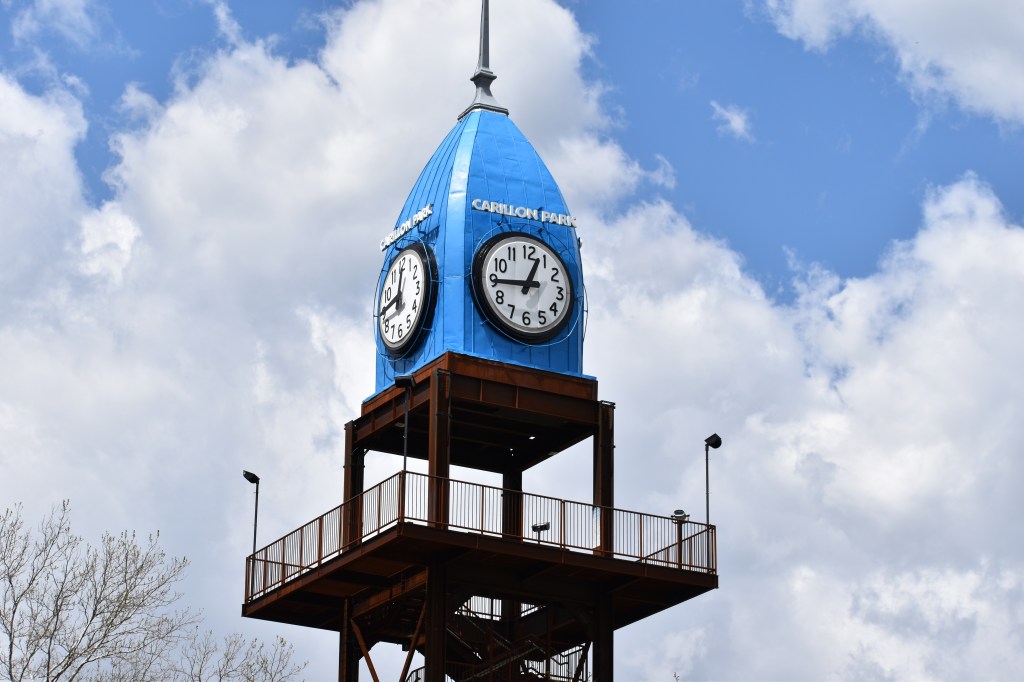

The Callahan Clock, Dayton, Ohio

Bald eagle nest, Carillon Park, Dayton, Ohio

2021 Progressive Poem is Finished!

A few days ago, I posted about providing a line to this year’s Kidlit Progressive Poem. Organized this year by Margaret Simon of Reflections on the Teche, there were 30 different poets who contributed to the project. They are all listed after the poem.

In addition to the final line of the poem itself, Michelle Kogan created a beautiful illustration for the work. I don’t have permission to share the illustration, but it can be found on the poems archive page here: 2021 Progressive Poem. It’s beautiful, and definitely worth checking out!

Progressive Poem, 2021

I’m a case of kindness – come and catch me if you can!
Easily contagious – sharing smiles is my plan.
I’ll spread my joy both far and wide
As a force of nature, I’ll be undenied.

Words like, “how can I help?” will bloom in the street.
A new girl alone on the playground – let’s meet, let’s meet!
We can jump-skip together in a double-dutch round.
Over, under, jump and wonder, touch the ground.

Friends can be found when you open a door.
Side by side, let’s walk through, there’s a world to explore.
We’ll hike through a forest of towering trees.
Find a stream we can follow while we bask in the breeze.

Pull off our shoes and socks, dip our toes in the icy spring water
When you’re with friends, there’s no have to or oughter.
What could we make with leaves and litter
Let’s find pine needles, turn into vine knitters.

We’ll lie on our backs and find shapes in the sky.
We giggle together: See the bird! Now we fly!
Inspired by nature, our imaginations soar.
Follow that humpback! Here, take an oar.

Ahh! Here comes a wave – let’s hold on tight,
splashing and laughing, let’s play until night!
When the Milky Way sparkles, and the moon’s overhead,
we make a pretend campfire and tell stories we’ve read.

Some stories are true and some myths of our time.
I love all of them, but my favorite ones rhyme!
With windows to see other lives, other places
We’ll find and treasure a rainbow of faces.

When you open your heart to a new friend
kindness for another kindles and ascends


Here’s a list of everyone who had a part of this year’s project:

April 1 Kat Apel at Kat Whiskers 
2 Linda Mitchell at A Word Edgewise
3 Mary Lee at A Year of Reading
4 Donna Smith at Mainly Write
5 Irene Latham at Live your Poem
6 Jan Godown Annino at BookseedStudio
7 Rose Cappelli at Imagine the Possibilities
8 Denise Krebs at Dare to Care
9 Margaret Simon at Reflections on the Teche
10 Molly Hogan at Nix the Comfort Zone
11 Buffy Silverman 
12 Janet Fagel at Reflections on the Teche
13 Jone Rush MacCulloch 
14 Susan Bruck at Soul Blossom Living
15 Wendy Taleo at Tales in eLearning
16 Heidi Mordhorst at my juicy little universe
17 Tricia Stohr Hunt at The Miss Rumphius Effect
18 Linda Baie at Teacher Dance
19 Carol Varsalona at Beyond Literacy Link
20 Robyn Hood Black at Life on the Deckle Edge
21 Leigh Anne Eck at A Day in the Life
22 Ruth Hersey at There is No Such Thing as a God-forsaken Town
23 Janice Scully at Salt City Verse
24 Tabatha Yeatts at The Opposite of Indifference
25 Shari Daniels at Islands of my Soul
26 Tim Gels at Yet There is Method 
27 Rebecca Newman
28 Catherine Flynn at Reading to the Core
29 Christie Wyman at Wondering and Wondering
30 Michelle Kogan at More Art 4 All

Black Locust


“How do you know it’s a black locust?”

It was a sincere question
and
honestly
I had to think
for a few seconds 
before I answered.

The easy answer
the one I didn’t give
was it couldn’t be anything else.

With those compound leaves
it wasn’t any of the oaks
or maples
redbud was out of the question
as was beech
and tulip poplar.

With those leaflets
as small and numerous as they were
ash, hickory
box elder
buckeye and even pecan
were off the list.

But on that late April morning
it was more than just 
seeing what it wasn’t

It was seeing what it had to be.

With those dangling clusters 
of wondrous white flowers
laden with nectar, pollen,
and bumble bees

It had to be a black locust.
It couldn’t be anything else.

“It’s the flowers,”
I said with a smile.


Just a note:

I know and understand that most people don’t know how to identify the trees around them.  Or the flowers, shrubs, and grasses.  There are so many I don’t know . . . lots more than I do. 

In the early grades, we often use what’s known as “environmental print” to help students to read.  Environmental print is helpful because almost everyone, even children at a young age, can recognize it — it’s ubiquitous and you know it at a glance.  

When I learn with people — especially young people — outdoors, it’s my hope that they would develop a familiarity with the world around them.  Much like recognizing the M that is the golden arches, it would be great if, at a glance, we could recognize the plants and animals around us.  

To paraphrase Aldo Leopold, we can’t love what we don’t know.

Conflict

Man vs. nature
I would write in the margins
back when I was made
to do such things

I remember that
along with man vs. man 
and man vs. self
— conflict

Now, some forty years later
as I walk the trails
and see 
what I see

I wonder why
I never wrote
nature vs. man
I wonder why

back when I was made
to do such things

—–

Just a note: I understand we more-accurately say character instead of man these days.  This poem takes me back to the 70s.  A lot of things were different back then. (And a lot of things weren’t.)

A Trio of Tankas

I think of greenbriar
in the early months of spring
their tendrils waving —
like me, they look for something
to bring them up to the light


Flitting in and out
of the brush beside the trail
the small bird beckons
entreating me to follow
where it knows I cannot go


I’m faced with a choice
two paths through the springtime wood
both calling to me —
I know, yes, I must decide
or simply stand there alone

So Much to Learn

My name is Tim, and I don’t know everything.

Isn’t that how it goes?  Admitting one’s problem so it’s possible to move on from it?  I don’t know for sure, after all: I just said I don’t know everything.

That said, in this case, I think I’m getting a clue. Just a clue, but it’s a start.

Okay, okay, okay…I used to think writing a haiku was easy.

Whew.

I wanted to write a few more paragraphs to build a bit of suspense and a touch of tension, but I had to just get it off my chest.  I couldn’t wait any longer.

I used to think writing haiku was easy.  I used to think haiku was the stuff of school poetry month in the early elementary grades.  I used to think 5-7-5…how hard can it be?  

I was wrong.  There’s a lot more to it, and I’m lovin’ it.

Before I go further, in my defense, it can be easy:

I’m just sitting here
looking at the cursor flash
wondering what’s next

The third line was the toughest of the three, but most of the difficulty came with deciding whether or not “wondering” had two syllables or three.  I deferred to Mirriam Webster and went with three, despite the fact that I usually say, “won-dring.”

Instead of “easy,” though, let’s go with “accessible.”  Because it is.  The example I just shared took me about a minute to write (“And it shows,” you whisper.) This morning my wife and I stood in the kitchen trying to come up with a haiku on the subject of rhyming with orange. We weren’t creating high art, but we were having fun. Poetry is supposed to be like that: fun!

Getting back to haiku, though: I still don’t know everything.  Not even close.  But over the past few weeks of National Poetry Month, I’ve read a lot of wonderful haiku, and I’ve learned a lot about the form.  I’ve even posted a few of my own, along with a few tankas, a skinny, a nonet or two, a haibun, and some free verse poetry. 

I’ll continue to learn, and I’ll continue to write.  To those of you who have served as mentors for my efforts, thank you!  


Thank you to the folks at Two Writing Teachers for hosting the Slice of Life Story Challenge! If you’ve not seen it, check it out at https://twowritingteachers.org


It doesn’t even have to be 5-7-5? Mind blown.  

Nonet: Trees

Yesterday I had the opportunity to participate in a fantastic breakout session that was part of the 2021 Fay B. Kaigler Children’s Book Festival hosted by the University of Southern Mississippi.  The session, with poets Irene Latham, Vikram Madan, and Laura Purdie Salas, was entitled Word-Joy: Experience the Transformative Power of Poetry.

It was a fantastic workshop, filled with plenty of material that I’ll put to use in my classroom very soon. Many thanks to Irene, Vikram, and Laura!

One of the forms I was introduced to today (thank you again, Irene) is called a nonet.  Nine lines, the first with one syllable, the second with two, and so on until the final with nine.  Sometimes the poem starts with the longest line and ends with the shortest.

Here’s one of the few that I wrote yesterday.

Trees

Trees
standing
tall and strong
with leaves blowing
and branches swaying.
As the spring months go by
and the summer days approach
I look forward to the long walks
the time spent beneath their canopies.

Split Horizons

Polonius got that one right...

Pocketful of Prose

Ponderings to Keep

Ms. Victor Reads

Reflections on my life as a teacher, reader, writer.

Merely Day By Day

Polonius got that one right...

I hablo espanglish

Polonius got that one right...

Live Your Poem...

Polonius got that one right...

Katie's Korner

Blogging my way through the year

The Biblio Bard Blogger

Polonius got that one right...

Poeturescapes

Polonius got that one right...

Soapbox: The Way I see Things

shouting my heart out for all who may listen

TeacherReaderWriter

Polonius got that one right...

litcoachlady

Lit On Fire!

Mar de Meditaciones

"It would be nice if you could just ravel out into time."